
Premium Lens Implant Options
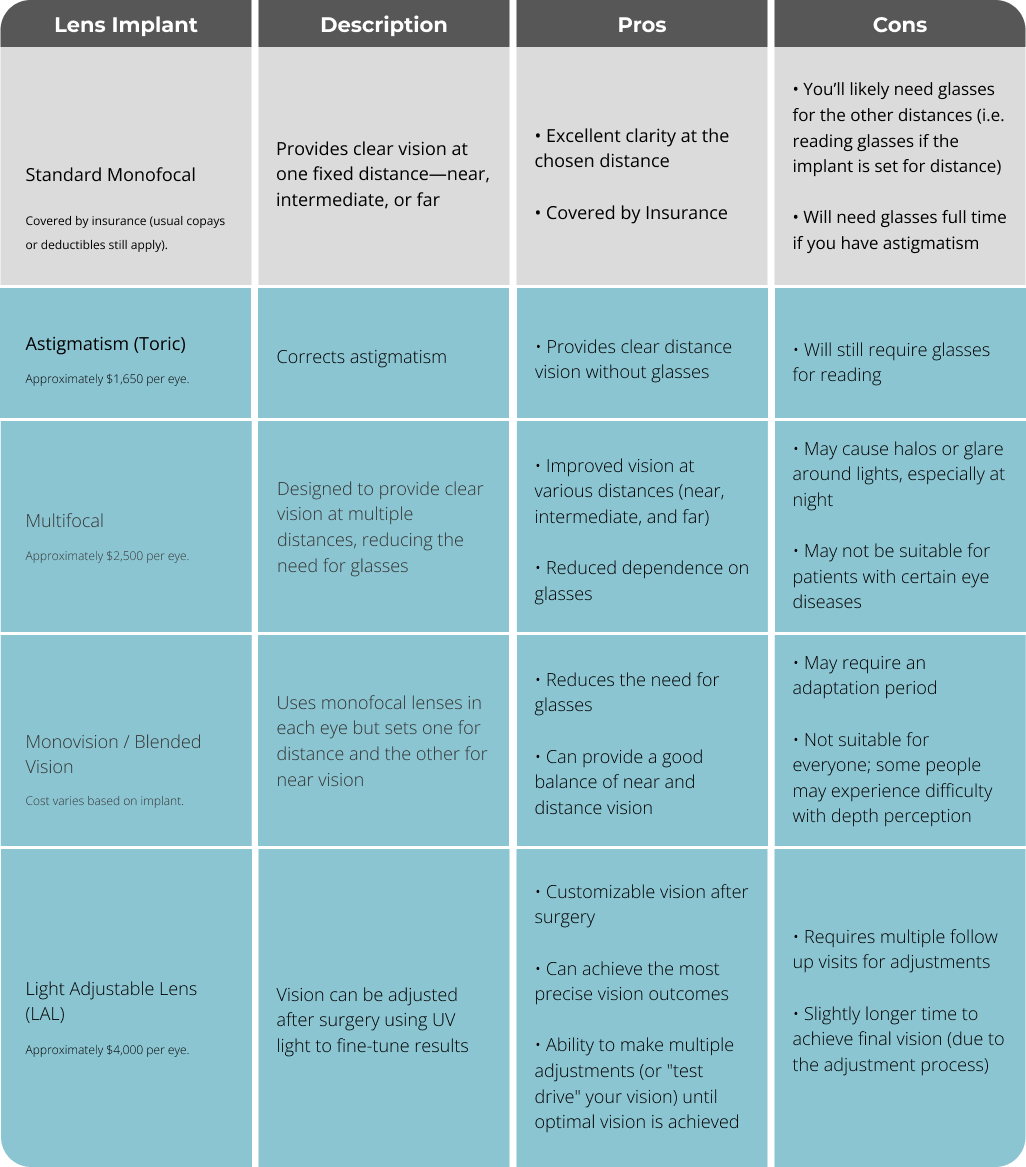
Insurance pays toward the cost of standard lens implants, but some advanced lens implants are not covered.
These optional lenses are designed to reduce your need for glasses and require an additional out-of-pocket fee beyond your usual copays and deductibles.

Astigmatism-Correcting Lenses
Approximately $1,650 per eye (in addition to your usual coinsurance and deductible)
These lens implants more fully correct the patient’s distance vision so that patients are less dependent on glasses for distance. Not all astigmatism is visually significant. Your doctor will discuss astigmatism-correcting lenses with you if your astigmatism is visually significant.
Nearly all patients with astigmatism who choose astigmatism-correcting lens implants see better without glasses than those who receive “standard monofocal” lens implants. Nearly all can pass a driver’s test, and many achieve 20/20 vision.
It is important to know that astigmatism-correcting lens implants are generally intended to improve distance vision. It is anticipated that patients will still want or need over-the-counter reading glasses.
Multifocal (AKA Trifocal) Lenses
Approximately $2,500 per eye (in addition to your usual coinsurance and deductible)
Lenses that focus light at both near and far distances may be referred to as “bifocal,” “trifocal,” “presbyopia-correcting,” or “extended depth” lenses. These types of lenses have more than one focal point or a range of focus points.
They are intended to help patients see both near and far with less dependence on glasses. However, they may not be a good choice for patients with certain eye diseases. Some eye conditions can negatively affect the performance of multifocal lenses. Your doctor will discuss whether you are a good candidate.
Multifocal lenses divide available light into focal points for near and far vision. While this can provide greater independence from glasses, some patients may experience side effects such as glare or halos, especially in certain lighting conditions.
While these side effects are not medically dangerous, they can be bothersome. They generally improve over time, and most patients report satisfaction with these lenses. Studies show high satisfaction rates.


Monovision or Blended Vision
Cost varies based on implant
For those familiar with monovision, it can be a good option for cataract surgery. However, not all patients find monovision satisfactory. For this reason, it is generally not recommended for patients who have not previously been successful with monovision contact lenses.
It is important to remember that patients with a history of monovision contact lens use can still wear monovision contacts after surgery, even if they do not choose monovision implants.
Light Adjustable Lenses (LAL)
Approximately $4,000 per eye (in addition to your usual coinsurance and deductible)
The desired focusing power of the lens implant is predicted using measurements and calculations taken prior to cataract surgery. While these measurements are accurate, they are not perfect.
Each eye is unique and heals differently, making the final focus impossible to predict with complete accuracy for every patient. Light Adjustable Lenses allow the focus to be changed after surgery.
You will preview possible vision outcomes with your doctor and choose a prescription based on your preferences and lifestyle needs. After surgery, you can “test drive” your vision and further customize it through a series of light treatments that precisely adjust your implanted lens.
The focus point of these lenses can be adjusted to near or far after surgery. This optimization is performed by your eye doctor through a series of light treatment procedures once the eye has healed.
These treatments are usually performed a few weeks after cataract surgery. Because the lens power is adjusted with light, patients must wear special glasses after surgery until adjustments are complete to protect the implant from unintended UV light exposure.
For more information on Light Adjustable Lenses, visit RxSight.com.
It is important to remember that the intended visual outcome cannot be guaranteed with any IOL. No implant choice can guarantee 20/20 or perfect vision.
Your doctor will discuss your lens implant options with you and help you decide which choice is best for your vision and lifestyle.

Important Information for Light Adjustable Lens (LAL) Patients
Follow-Up Schedule
With the Light Adjustable Lens, you have the ability to change the focusing power of the lens after cataract surgery. This allows you to fine-tune your vision to your exact visual needs and “test drive” your vision, making multiple changes if necessary to fully customize your results.
Your eyes need to heal completely from surgery before these adjustments begin. During the first 3–4 weeks after surgery, your follow-up schedule will be the same as any other cataract surgery patient. You will see your regular optometrist or surgeon one day and one week after surgery for each eye, at your preferred location.
Once your eyes are fully healed—typically around 3–4 weeks after surgery on your second eye—you will begin the adjustment process. This will involve multiple visits (at least 3 additional visits and often up to 5 or more) to fully customize your vision.
These visits will be with one of our doctors who is specially trained in the LAL lens and will take place at our Nifong office in Columbia.
Post-Op UV-Blocking Glasses
After surgery, you will need to wear the special UV-blocking glasses provided by your doctor. You will wear these glasses until you have completed all post-op visits.
The purpose of these glasses is to protect your lens implant. After surgery, your implant is customized to your specific vision needs using UV light. These glasses block UV rays from the sun to prevent any unintended changes to the implant before your final adjustment. Wearing them as directed helps ensure the best possible results for your vision.
You will receive three different pairs of UV-blocking glasses:
- Tinted Pair These are to be worn anytime you are outside.
- Clear Pair (No Prescription) These should be worn anytime you are indoors.
- Clear Pair With Bifocal These can be used in place of the clear pair with no prescription for reading. The bifocal portion will sharpen your near vision.
Summary of Premium Your Lens Implant Choices
Scheduling
Cataract surgery is an outpatient procedure that is done when the patient feels their vision is affecting their quality of life. Except in rare cases, waiting weeks or months to have the surgery will not make the surgery or recovery any more difficult.
It is best to schedule the surgery at a time when you can take the best care of your eyes. If you have an upcoming trip, busy work schedule, important activity, or family commitment, consider waiting until after these events have passed.
Usually, 5–10 days after surgery, patients are free of restrictions and can return to normal activities and travel.
Cataract surgery is a medical procedure that is covered by your medical insurance. You do not need a vision plan or vision supplement for eye surgery. You may be responsible for copays or deductibles, depending on your insurance plan.
On the day of surgery, you will be at the surgery center or hospital for 2–3 hours. You should rest and take it easy for the next couple of days.
You will have a follow-up appointment the next day or later that same afternoon. You will have a second follow-up appointment 1 to 2 weeks later. If your other eye needs surgery, that procedure is usually scheduled 2–4 weeks after the first.
Some patients may be able to schedule follow-up appointments with the optometrist who sees them regularly. You are free to choose whether to follow up with your optometrist or the operating surgeon.
You will need someone to drive you on the day of surgery and for your first postoperative appointment. Most patients are cleared to drive after the first postoperative appointment.
The surgery scheduler will provide the exact addresses and times for all your appointments.
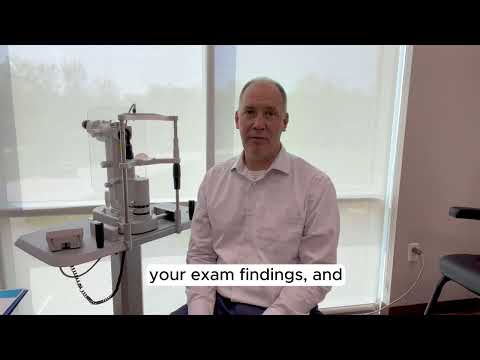
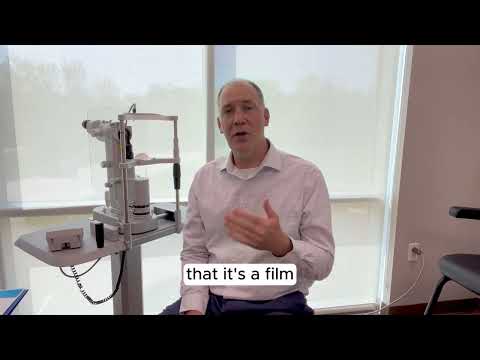
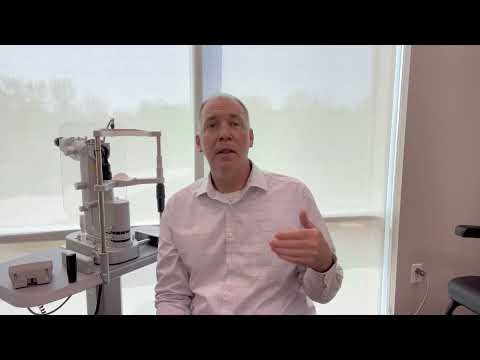
Watch our Cataract Surgery Playlist
for more information on all your cataract questions

Meet The surgeons
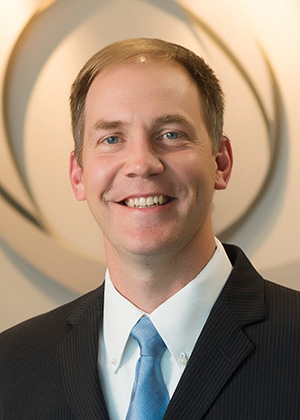
Nathan Hesemann, MD
Dr. Hesemann grew up Gasconade County and graduated from the University of Missouri School of Medicine, where he also trained to be an eye surgeon. After practicing in St. Louis for several years, he returned to Columbia. He has been part of Missouri Eye Consultants since 2016. He also provides patient care, student teaching, and research at the Harry S Truman VA and MU School of Medicine. He is a comprehensive ophthalmologist, which means he takes care of medical and surgical diseases like cataracts, glaucoma, macular degeneration, and diabetes. He enjoys teaching eye care and goes on medical mission trips each year.
Dr. Hesemann lives in Columbia with his wife and three daughters. He enjoys spending time with family, being on the water and coaching basketball.
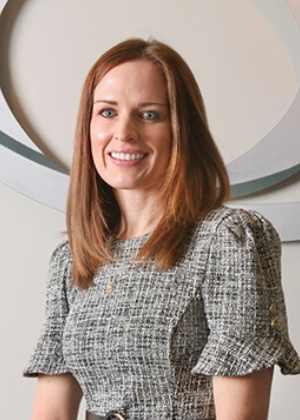
Maggie Cardonell, M.D.
Originally from Kansas City, her professional journey includes medical and surgical work in Asia, Africa, Central and South America, and across the Midwest. This experience has not only shaped her empathetic approach to eye care but also fueled her ongoing passion for travel. When she’s not improving vision, she enjoys exploring, spending time at the lake, and creating memories with her husband, three children, and their dog Cookie.
Dr. Cardonell is a dedicated ophthalmologist committed to enhancing the quality of life for her patients through exceptional eye care. She brings a compassionate approach and unique global perspective to our practice, which are both enriched by her extensive travels.
Seven Convenient Locations
for All of Your Eye Care Needs

Missouri Eye Consultants -
Columbia (Keene St.)
500 N Keene St Suite 103
Columbia, MO 65201
Missouri Eye Consultants - Columbia on Nifong
900 W Nifong Blvd Suite 125
Columbia, MO 65203
